

CONTACT US
Correspondence is welcome when offered in the same spirit in which this work is shared. Readers who wish to reflect on the themes explored here, or who wish to suggest topics and questions for further study, are invited to do so by email. Messages are received as considerations, not conversations, and there is no expectation of reply. The purpose of correspondence is not discussion or persuasion, but the quiet exchange of insight and direction for continued inquiry.
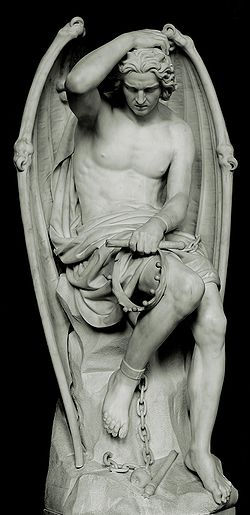
Guillaume Geefs described his sculpture of Lucifer — also known as Le Génie du Mal (The Genius of Evil) — as a moral and psychological study rather than a celebration of rebellion. He did not intend to glorify defiance or portray evil as monstrous excess. Instead, he sought to show what remains after the fall: intelligence intact, beauty not yet erased, and power still visible, but turned inward and diminished by its own misdirection.
Geefs understood Lucifer as fallen intelligence rather than grotesque caricature. The calm posture, downward gaze, and restrained expression are deliberate. This is not the moment of revolt, but its aftermath. Lucifer is shown as aware, reflective, and inwardly collapsed. The broken chains signify freedom misused rather than freedom achieved. The bat-like wings and lowered head do not announce triumph, but degeneration—light folded back upon itself, consciousness no longer oriented outward toward the Whole.
When critics objected that the figure was “too beautiful,” Geefs acknowledged the tension and insisted it was essential. Evil persuades precisely because it retains traces of the good it has lost. To render Lucifer ugly would be dishonest, because the tragedy lies in contrast, not deformity. The sculpture warns that intellect without humility decays inwardly, and that moral collapse often appears composed, dignified, and even compelling on the surface.
Viewed through the lens of Sophothéōsis, the sculpture becomes more than a theological illustration. It reads as an image of misdirected consciousness. Lucifer is not an external adversary, but awareness severed from its source — brilliant, self-aware, and isolated. The fall is not spatial or punitive; it is orientational. Intelligence turns toward itself rather than remaining grounded in Being. What follows is not violent corruption, but implosion: unity fractured into self-enclosure.
In this light, Geefs’s Lucifer stands as a cautionary figure within the broader inquiry of Sophothéōsis. He embodies beauty without alignment, freedom without grounding, intelligence without surrender. The statue does not accuse from without; it reveals from within. It shows what consciousness becomes when it forgets its participation in the One — still luminous, still powerful, but no longer whole.
It is worth noting that the presence of this statue here is also intended as a warning. Light, when misaligned, does not cease to be light; it turns inward and becomes destructive through isolation. Insight separated from humility, understanding detached from grounding in the One, can harden into self-reference and quiet pride. Even a site devoted to reflection and awakening can become a place of inward collapse if its contents are taken as possession, identity, or superiority rather than orientation. What is shared here must therefore be held lightly and returned continually to its source. The reader is invited to remain grounded in the One, allowing illumination to clarify rather than isolate, and remembering that true Light does not terminate in the self, but passes through it without remainder.